


by Mark Wallace
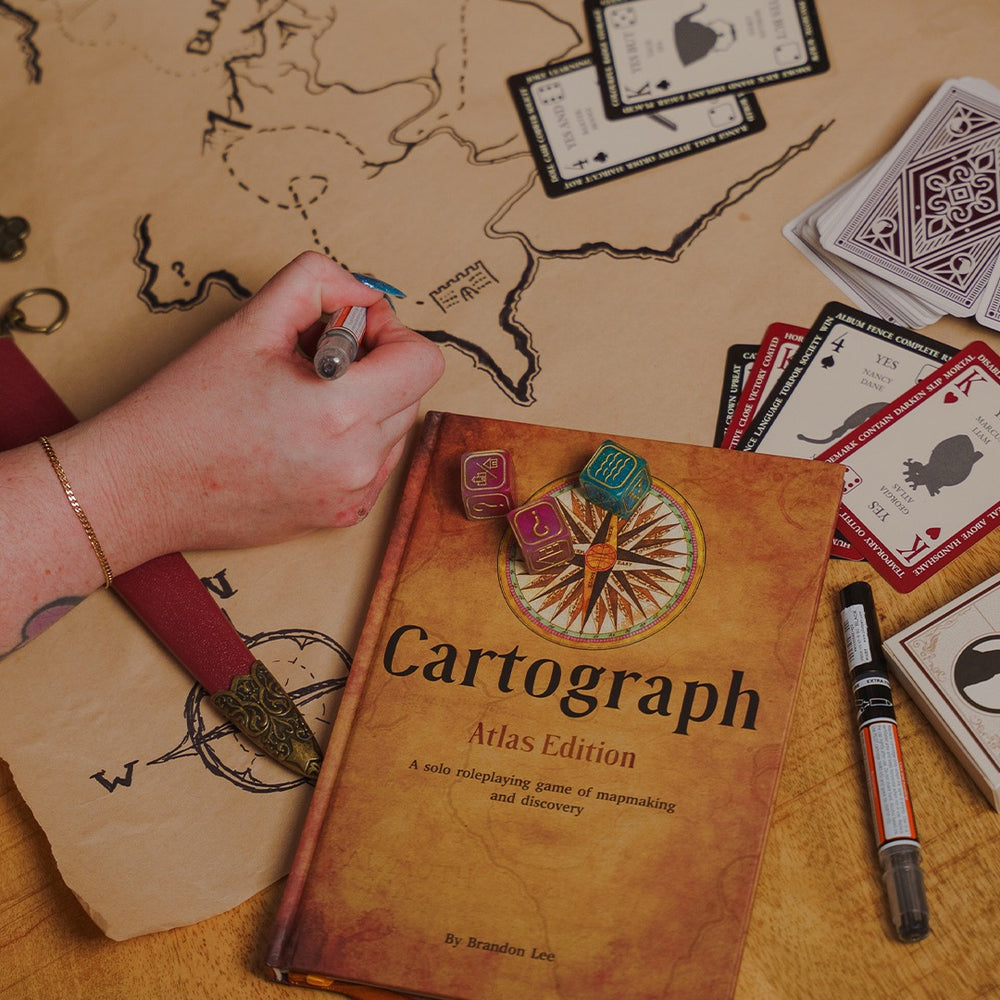
The difference between a picture and a story is time. In Cartograph, "a solo roleplaying game of mapmaking and discovery," you draw a picture — a map — by taking on the role of an explorer traversing a land they've never visited before. As you do, you encounter new locations, come into contact with characters and cultures, and, over time, tell some of your explorer's story as they travel to these places for the first time.
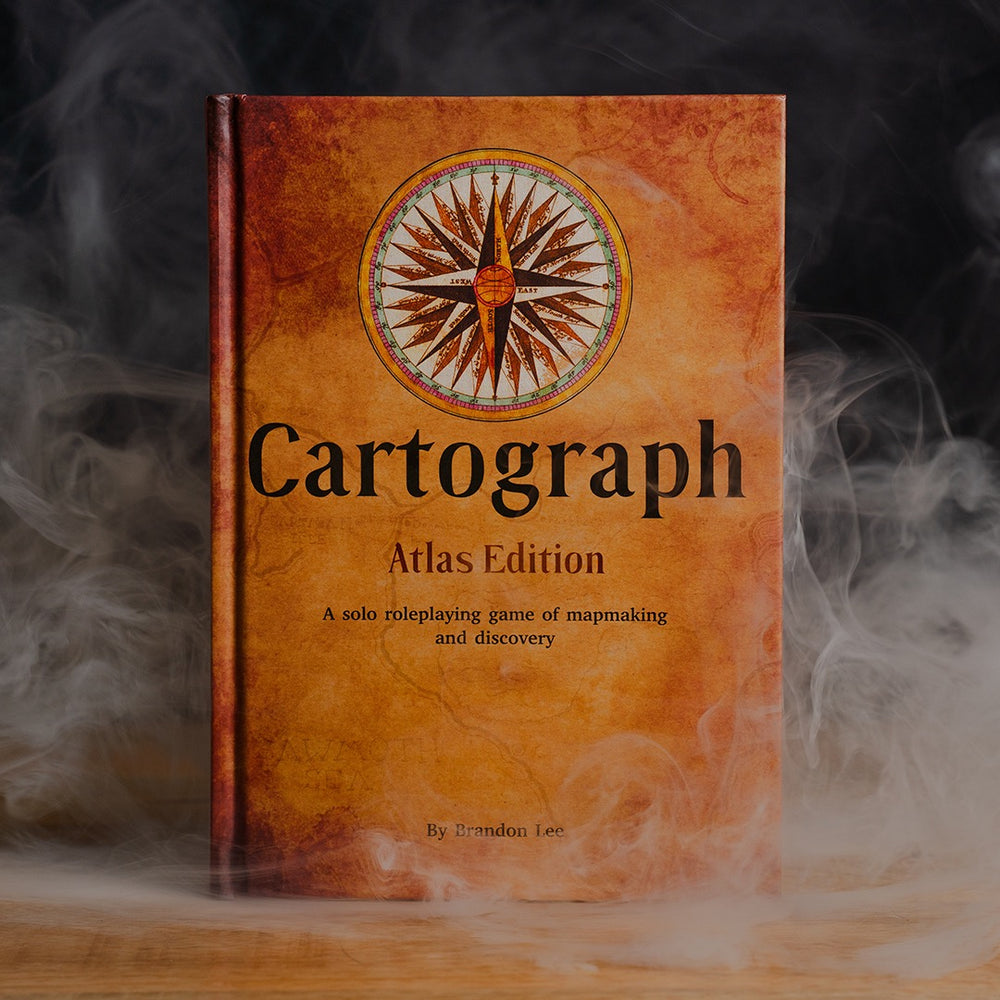
I love exploration in games, and I love maps, and I especially love maps of imaginary places, so Cartograph was a game I've been very interested to pick up. The maps that emerge from The Quiet Year are some of my favorite gaming artifacts, and exploration games like Exclusion Zone Botanist keep me pushing further and further into the Zone, despite (or perhaps because of) the simple, streamlined framework they provide.
Cartograph, created by Brandon Lee, who is part of Australian RPG design studio The Ravensridge Emporium, started life as an apparently somewhat simpler mapmaking game, and those genes are very strongly in evidence in the hardcover Atlas Edition. The roleplaying elements in Cartograph are layered in with a light touch, and that is both the game's strength and its weakness.
Your game begins with the creation of your explorer. A few tables give you a name, something you value (Safety, Thrill, Affirmation, etc.), your disposition (Unimpressed, Focused, Curious, etc.), and some markers of appearance. You also get one of six specializations, each of which gives you a different starting bonus in terms of the dice and other resources you'll use to make your way through this undiscovered (by you) land.
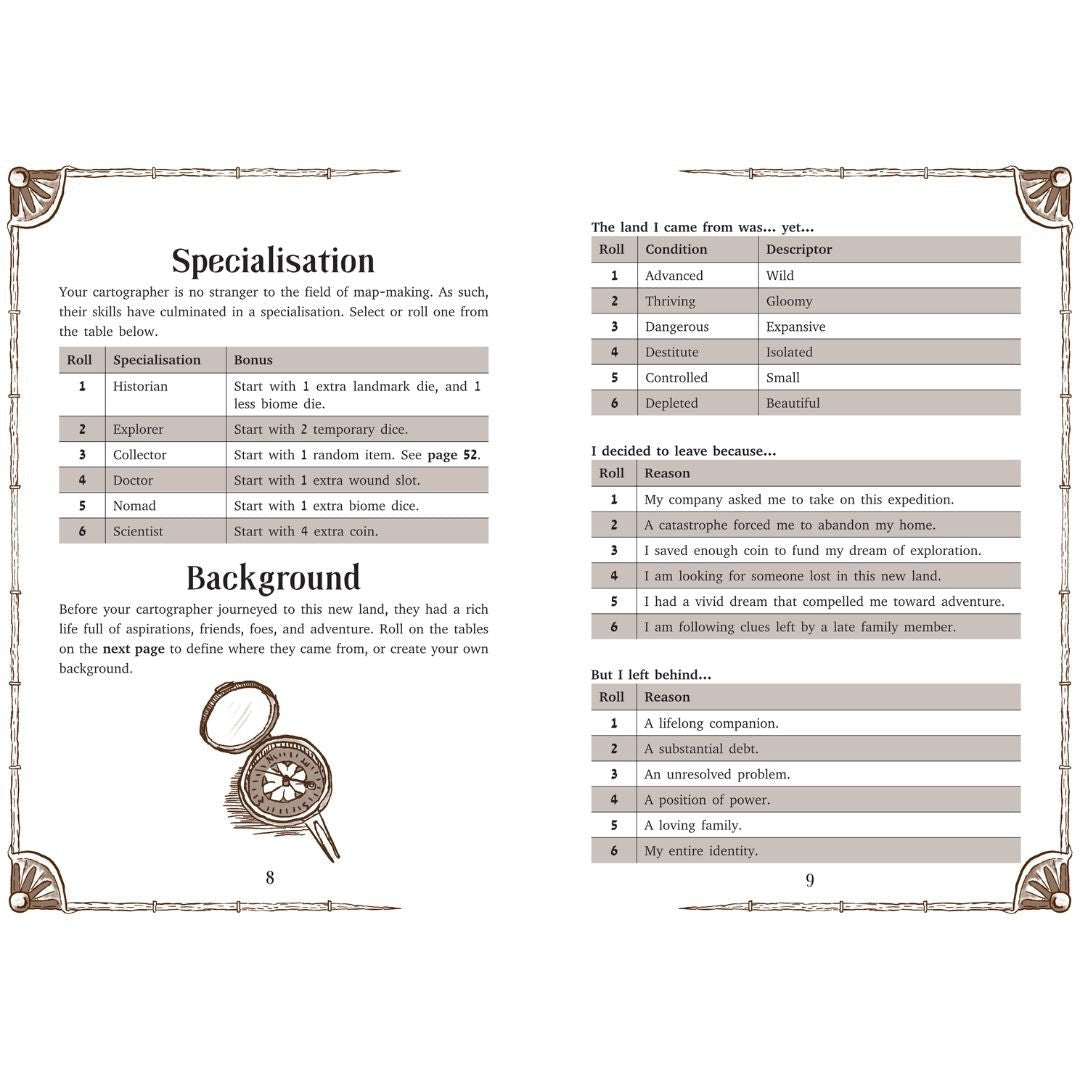
A few more short tables tell you just a bit about the land you came from, why you left, and what you left behind. But why you left and what you left behind have only six entries each. This might be fine if each choice struck out very strongly in its own direction, but the entries that create your explorer are very broad. They provide some color for your story, but not as much purpose. As a result, the six entries on each table wind up feeling like they've been plucked from a treasure chest that must contain many more. It's unclear why we're limited to six; it's enough to get started, but it left me wanting more.
A Solid Map
I stumbled on that feeling of wanting more a few times in several play-throughs of Cartograph. The core mapmaking bits are solid. Your dice come in three flavors: landmark dice, which define both landmarks and coastlines; biome dice, which dictate the features of the natural environment, such as forests, rivers, mountain ranges, etc.; and temporary dice, which can be used as either, at your discretion. Roll them close together onto the piece of paper that will become your map, and mark coastlines of "no more than a few centimetres" around each of the landmark dice. Each landmark die also marks a landmark you can travel to, which are either settlements of various sizes, or a more mysterious "discovery."
Each of these things has tables that provide names and a bit of guidance to flesh things out. Many of the prompts dangle promising stories. A crashed vehicle with a journal discovered in the wreckage. A city of people who live in underground networks. A sentient forest that engages you in conversation. The questions fire your imagination, and the answers point you toward new directions to explore.
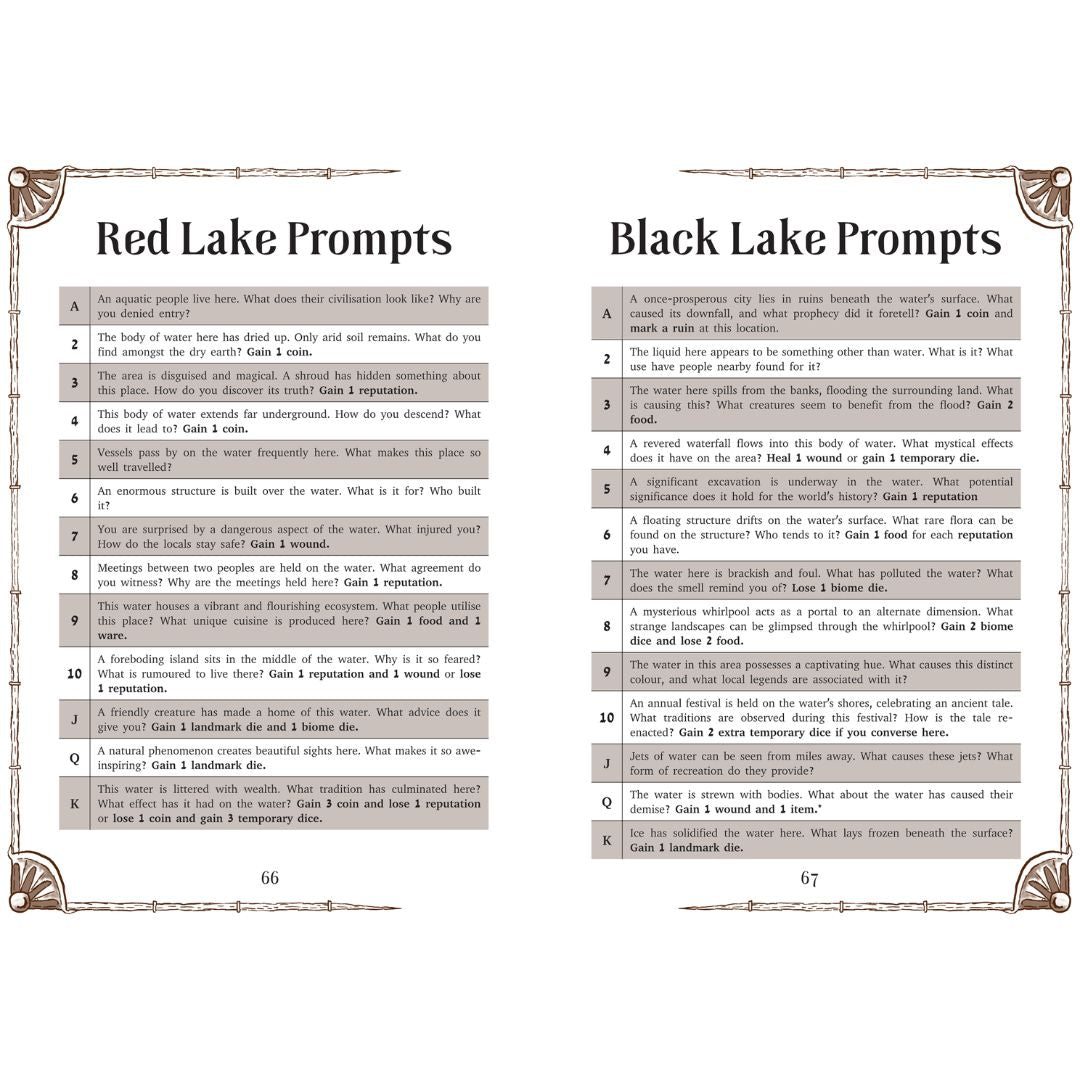
But too many of the prompts simply close the circle on a place's description, with nothing left to resolve. It's interesting to know that you've reached "a generous city of wealth," but answering the question of "what characteristic about the city reveals its prosperity" doesn't tell me much about how I'll spend my time here.
Alien Interloper
The maps the game generates are satisfying pictures of a land that felt like it had clearly been in existence for some time before my explorer arrived. And Cartograph does, for the most part, sidestep the issue of colonialism that hangs around the edges of any game about exploration. Still, the word "explore" originates as a hunter's cry, apparently, and does imply a traveler uncovering a land that was previously unknown. But unknown to whom? The rulebook is in conflict with itself on this point. "Remember that [you] are an interloper into this land," it says. Then, "This place is alien and unfamiliar." But it is not the place that is alien, it is the explorer. Thinking of your character as a visitor or refugee or immigrant might be more appropriate — and might also help bring a bit of the purpose to your wanderings.
This purpose is what I wanted more of from Cartograph. There is a light layer of resource management as you consume food and acquire and sell wares, but very rarely did I feel like much was at stake. The land gradually came into focus as I played, but for my explorer there was little sense of pressure and little sense of progress. I may have decided to leave the land I came from because I was "following clues left by a late family member," but the game never asks me about this point of my history again. The player is asked to keep things like this in mind, but without moments that speak more directly to the progress I'm making or the peril I risk, this felt a lot like being asked to draw an owl.
For the Cartographers
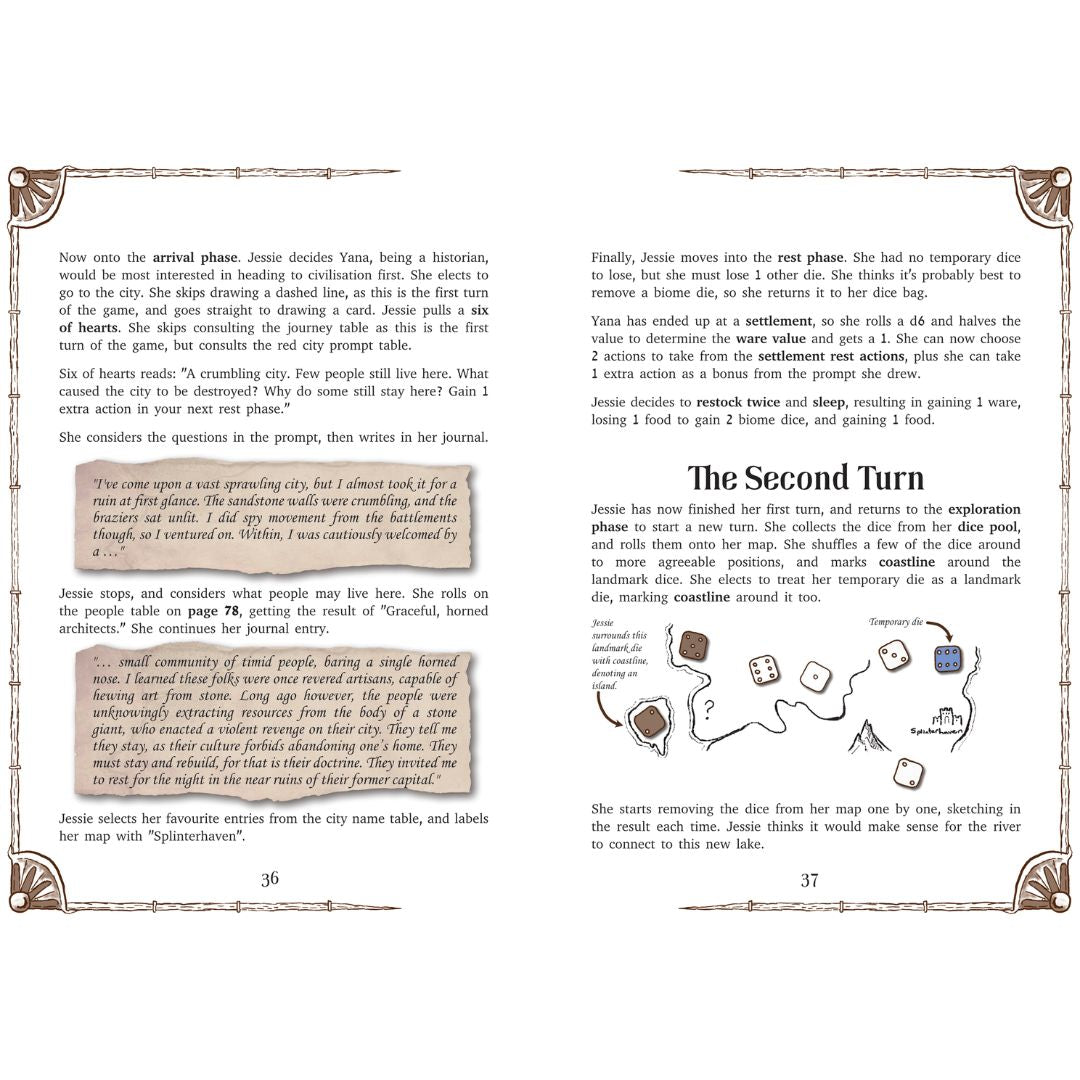
Cartograph does a better job of teaching you to draw a map, though, and feels like a great tool for creating places in which a rich story might unfold. It felt slightly more difficult to navigate the book than to navigate the land it generates, but the picture one ends up with at the end of a game of Cartograph feels like it holds great potential. If you like making maps and making places, the game is worth exploring. In fact, it's such a place-centric game that one of the triggers that ends the game is simply naming ten places. Place might upstage time in this game, but if you're interested in watching a place take shape before your eyes, there's a really interesting toolset tucked in the pages of Brandon Lee's game.
Mark Wallace (he/him) has written about games for Shut Up & Sit Down, Rock Paper Shotgun, and The Escapist, as well as hobbyist publications like The New York Times, GQ, Wired, and many more. Find him on Bluesky at @markwallace.bsky.social.

Comments (0)
There are no comments for this article. Be the first one to leave a message!